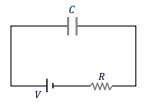
1. As in figure shown, if a capacitor C is charged by connecting
it with resistance R, then energy is given by the battery will
be
a) \[\frac{1}{2}CV^{2}\]
b) More than \[\frac{1}{2}CV^{2}\]
c) Less than \[\frac{1}{2}CV^{2}\]
d) Zero
Explanation: Some energy lost in the form of heat in resistance also.
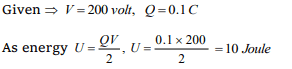
2. A capacitor is charged to 200 volt it has 0.1 coulomb charge.
When it is discharged, energy will be
a) 1 J
b) 4 J
c) 10 J
d) 20 J
Explanation:
3.If eight identical drops are joined to form a bigger drop, the
potential on bigger as compared to that on smaller drop will
be
a) Double
b) Four times
c) Eight times
d) One time
Explanation:

4. If a dielectric substance is introduced between the plates of
a charged air-gap capacitor. The energy of the capacitor will
a) Increase
b) Decrease
c) Remain unchanged
d) First decrease and then increase
Explanation:

5. A \[40\mu F\] capacitor in a defibrillator is charged to 3000 V. The
energy stored in the capacitor is sent through the patient
during a pulse of duration 2ms. The power delivered to the
patient is
a) 45 kW
b) 90 kW
c) 180 kW
d) 360 kW
Explanation:

6.A spherical drop of capacitance \[1\mu F\] is broken into eight
drops of equal radius. Then, the capacitance of each small
drop is ......
a) \[\frac{1}{8}\mu F\]
b) \[8\mu F\]
c) \[\frac{1}{2}\mu F\]
d) \[\frac{1}{4}\mu F\]
Explanation:

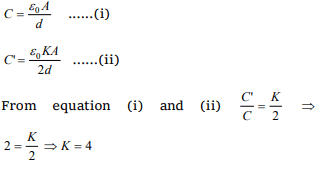
7. An air filled plate capacitor has capacity C. If distance between plates is doubled and it is immersed in a
liquid then capacity becomes twice. Dielectric constant of
the liquid is
a) 1
b) 2
c) 3
d) 4
Explanation:
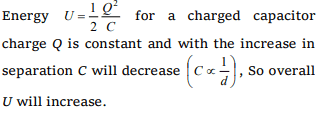
8. On increasing the plate separation of a charged condenser,
the energy
a) Increases
b) Decreases
c) Remains unchanged
d) Becomes zero
Explanation:
9. The energy stored in a condenser is in the form of
a) Kinetic energy
b) Potential energy
c) Elastic energy
d) Magnetic energy
Explanation: Potential energy
10. When a dielectric material is introduced between the plates
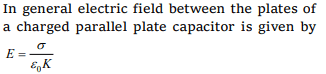
of a charges condenser, then electric field between the
plates
a) Remain constant
b) Decreases
c) Increases
d) First increases then decreases
Explanation: