1. 1000 small water drops each of radius r and charge
q coalesce together to form one spherical drop. The
potential of the big drop is larger than that of the smaller
drop by a factor of
a) 1000
b) 100
c) 10
d) 1
Explanation:

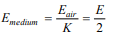
2. A parallel plate condenser is immersed in an oil of dielectric
constant 2. The field between the plates is
a) Increased proportional to 2
b) Decreased proportional to \[\frac{1}{2}\]
c) Increased proportional to \[\sqrt{2}\]
d) Decreased proportional to \[\frac{1}{\sqrt{2}}\]
Explanation:
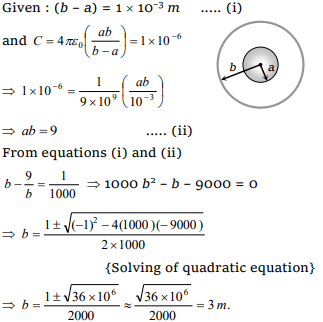
3.The capacitance of a spherical condenser is \[1\mu F\] . If the
spacing between the two spheres is 1 mm, then the radius
of the outer sphere is
a) 30 cm
b) 6 cm
c) 5 cm
d) 3 cm
Explanation:
4. If the dielectric constant and dielectric strength be denoted
by k and x respectively, then a material suitable for use as
a dielectric in a capacitor must have
a) High k and high x
b) High k and low x
c) Low k and low x
d) Low k and high x
Explanation: High K means good insulating property and high x means able to withstand electric field gradient to a higher value.
5. When air in a capacitor is replaced by a medium of
dielectric constant K, the capacity
a) Decreases K times
b) Increases K times
c) Increases \[K^{2}\] times
d) Remains constant
Explanation:

6. 64 drops each having the capacity C and potential V are
combined to form a big drop. If the charge on the small drop
is q , then the charge on the big drop will be
a) 2 q
b) 4 q
c) 16 q
d) 64 q
Explanation:

7. The capacity of a parallel plate capacitor increases with the
a) Decrease of its area
b) Increase of its distance
c) Increase of its area
d) None of the above
Explanation:

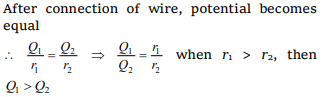
8. The radius of two metallic spheres A and B are r1 and r2
respectively \[\left(r_{1}> r_{2}\right)\] . They are connected by a thin wire and
the system is given a certain charge. The charge will be
greater
a) On the surface of the sphere B
b) On the surface of the sphere A
c) Equal on both
d) Zero on both
Explanation:
9. The capacity of a spherical conductor in MKS system is
a) \[\frac{R}{4\pi\epsilon_{0}}\]
b) \[\frac{4\pi\epsilon_{0}}{R}\]
c) \[4\pi\epsilon_{0} R\]
d) \[4\pi\epsilon_{0} R^{2}\]
Explanation: \[4\pi\epsilon_{0} R\]
10. Can a metal be used as a medium for dielectric
a) Yes
b) No
c) Depends on its shape
d) Depends on dielectric
Explanation: Because metals are good conductor of electricity